Features of Legal Platforms That Disclose Performer Identity Verification and Consent Procedures
A platform calling itself “legal,” displaying an 18+ notice, or accepting major payment cards does not prove that every piece of content was produced and distributed with valid consent.
Because users cannot inspect a platform’s private records, the practical question is whether the platform publicly explains who is verified, when verification occurs, what the performer agreed to, and what happens when consent is disputed.
For Korean users, the platform’s legal status overseas is also not a complete safeguard. Korean law can apply to non-consensual distribution even when the original filming was consensual. The content itself, not only the platform’s business status, must therefore be considered.

A “Legal” Label Is Not the Same as Verified Consent
A platform calling itself “legal,” displaying an 18+ notice, or accepting major payment cards does not prove that every piece of content was produced and distributed with valid consent.
Because users cannot inspect a platform’s private records, the practical question is whether the platform publicly explains who is verified, when verification occurs, what the performer agreed to, and what happens when consent is disputed.
For Korean users, the platform’s legal status overseas is also not a complete safeguard. Korean law can apply to non-consensual distribution even when the original filming was consensual. The content itself, not only the platform’s business status, must therefore be considered.
A Viewer Age Check Does Not Verify the Performers
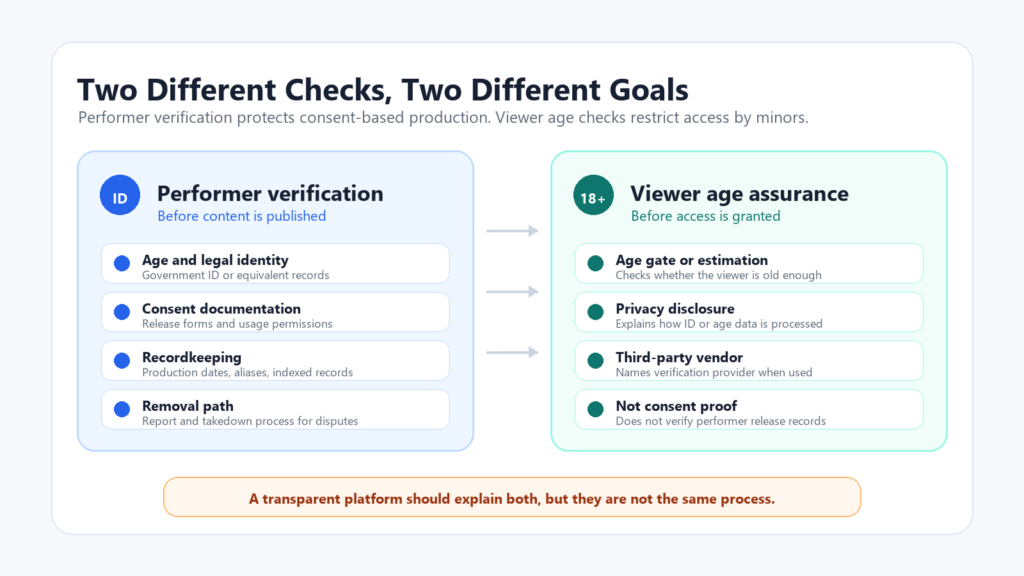
A user-facing age gate and performer verification serve different purposes.
Viewer age checks are intended to prevent minors from accessing adult material. Ofcom’s guidance, for example, describes age assurance as a way to prevent children from reaching pornographic content. That does not show that the identities and ages of the people depicted were verified.
Performer Identity and Age Verification Should Be Publicly Documented
A credible platform does not simply state “all creators are 18+.” It explains the actual procedure: government-issued identification, legal name, and date of birth are collected and validated for every performer — not just the uploading account — before content is published, and those records are retained rather than discarded after a one-time check.
18 U.S.C. § 2257 (the US federal record-keeping statute governing sexually explicit content) requires producers to verify the age and identity of every performer using government-issued identification and to retain those records, along with the name and address of the custodian responsible for them. The implementing regulation, 28 CFR Part 75, sets out the specific documentation, indexing, and inspection requirements producers must follow. Mastercard’s current merchant standards go further for platforms hosting third-party uploads: they require verification of the uploader’s government-issued ID, documentation of the identity and age of every person depicted (not only the account holder), and content review before publication.
A credible performer-verification policy should state that:
- Only verified creators can upload or stream content.
- Government-issued identification is validated before publication.
- Every person depicted is verified, not only the account owner.
- Collaborators must provide supporting identity and age records.
- Live content can be monitored and stopped when necessary.
A statement such as “all creators are 18+” is therefore weaker than a policy explaining how every depicted person is checked before the content becomes available, and weaker still if it doesn’t describe how long identity records are kept or who is responsible for them.
Consent Must Be Documented Per Piece of Content, Not Once Per Account
Consent to appear in a recording is not automatically the same as consent to upload, publicly distribute, Consent to appear in a recording is not automatically the same as consent to upload, publicly distribute, sell, license, or allow users to download it. A one-time account-level consent checkbox does not establish this — a transparent platform keeps a separate consent record tied to each specific piece of content, covering:
- Consent to be depicted
- Consent to upload and publicly distribute the content
- Consent to make the content downloadable
- Consent for later reuse, resale, editing, or licensing, where applicable
- The scope of monetization and which platforms the content may be distributed to
- A documented process for withdrawing consent or requesting removal
Mastercard’s standards distinguish consent to be depicted from consent to public distribution and, when downloads are offered, consent to allow downloading. This distinction is particularly relevant in Korea. Korean law recognizes that distribution against the depicted person’s wishes can be punishable even when the person originally agreed to the filming. A platform that mentions only “consent during production” has therefore not explained enough about distribution rights.
The policy should also explain how collaborator content is handled. Requiring only the uploader to click a consent box is not enough when other people appear in the content.
Review Should Happen Before Publication, With a Defined Complaint Process After
A report button is useful, but it is not a substitute for checking content before it goes live.
A stronger platform explains that uploads are reviewed before publication — checking identity records, consent scope, and signs of illegal or non-consensual content — and that live streams can be monitored in real time. Its public policy should also prohibit content involving minors, trafficking, coercion, hidden recording, impersonation, or non-consensual distribution.
The removal process should answer practical questions:
- Can a depicted person report content without controlling the uploader’s account?
- Is there a dedicated category for lack of consent?
- Is the content restricted while the claim is investigated?
- What evidence will the platform examine?
- How quickly does it respond?
- Can the depicted person appeal an incorrect decision?
Under Mastercard’s current standards, relevant merchants must maintain a complaint process, review reported complaints within seven business days, immediately remove content found to be illegal, and provide a removal appeal for a person depicted in the content. If valid consent cannot be established, the content must be removed.
These are payment-network requirements rather than proof that a particular platform follows them correctly. They are best used as a benchmark when reading the platform’s creator rules, consent policy, and takedown procedure — a full pre-publication-to-appeal pipeline, publicly described with timelines, is a meaningfully stronger signal than a bare “report abuse” link.
Transparency and Accountability Should Be Easy to Find
If a platform actually operates these procedures, the documentation should not be hard to locate. A trustworthy operator makes the following easy to find: its terms of service, a 2257 compliance notice (or equivalent record-keeping disclosure), its content policy, a reporting/complaint form, an explanation of how identity documents are stored and for how long, and contact information for whoever is responsible for compliance and records.
A page that only asserts “we operate legally” without naming a jurisdiction, an operator, or a dated policy is a weaker signal than a platform that documents its verification criteria, retention practices, and enforcement steps in specific, checkable terms. Identity-data handling deserves particular scrutiny: a platform that collects government ID without explaining who processes it, why it’s needed, and when it’s deleted has left out one of the most sensitive parts of the process.
Use Public Evidence, Not Vague Trust Claims
The following signals are more useful than a general statement that a platform is “safe” or “fully compliant.”
| Area to check | Stronger public evidence | Weak signal or warning sign |
|---|---|---|
| Performer verification | The policy explains how the uploader and every depicted person are verified before publication, with records retained | An 18+ badge or verification of only the account owner |
| Consent records | Separate, per-content consent for appearance, public distribution, downloading, and relevant reuse | A blanket statement that “all participants consented” |
| Content review | Pre-publication review and real-time controls for live content | Content is reviewed only after users complain |
| Removal rights | A dedicated reporting route for depicted people, response times, and an appeal process | Only a generic support email or copyright form |
| Accountability | Identifiable operator, jurisdiction, dated policies, a 2257-style compliance notice, and clear enforcement steps | No company details, outdated policies, or contradictory terms |
| Identity-data privacy | The platform explains who processes identity documents, why they are collected, and how long they are retained | It requests identification without explaining storage or deletion |
Payment logos, an app-store listing, or a polished trust page can support an assessment, but none independently certifies that every uploaded item has valid consent.
When to Consider, Verify Further, or Avoid a Platform
A platform is reasonable to consider when its creator guidelines, terms, consent policy, and reporting process provide consistent details about pre-publication identity checks, consent scope, content review, and removal rights.
It needs further verification when it claims to verify everyone but does not explain whether collaborators are checked, whether verification occurs before publication, or how a depicted person can dispute consent. In that case, review recent transparency reports or ask support specific questions before relying on the claim.
It is safer to avoid the platform when anonymous users can upload content, only the uploader is verified, consent is described vaguely, there is no performer-focused takedown process, or the site’s policies contradict one another.
For Korean users, do not treat the words “legal platform” as permission to possess, view, download, or redistribute any file found there. Korean law criminalizes knowing possession or viewing of child or youth sexual exploitation material, and Korean law also addresses non-consensually distributed intimate recordings.
The most meaningful trust signal is not a legal label. It is a documented process that verifies every depicted person before publication, records consent for the specific use of the content, and gives performers an effective way to challenge or remove material.