Criteria for Distinguishing Original, Remastered, Remixed, and Live Audio Based on Sound Quality and Arrangement
Do not identify a version only by asking which one sounds clearer or louder. Start by checking whether the performance, arrangement, or mix has changed.
The most important distinction is this: a remaster normally processes the completed mix as one piece, while a remix returns to individual recording elements such as vocals, drums, and guitars and combines them again. A live version uses a different performance altogether.

Use This Listening Test First
Compare the same distinctive section in both versions, such as the intro, first chorus, instrumental solo, or ending.
| What you hear | Most likely version | What to compare |
|---|---|---|
| The performance and instrumental balance are the same, but the overall tone, loudness, or noise level differs | Remastered | Hiss, bass weight, treble, stereo width, and overall loudness |
| The same basic recording is used, but vocals, drums, effects, stereo positions, or song sections sound different | Remixed | Instrument levels, panning, reverb, edits, and structure |
| Vocal phrasing, solos, tempo, transitions, or endings differ from the studio recording | Live | Performance differences, venue ambience, improvisation, and audience response |
| It matches the first officially released version and shows none of the later changes above | Original | Original release date, credits, and edition information |
A remix does not always have a new beat or a radically different arrangement. It may preserve the song’s structure while changing the prominence, position, or effects of individual instruments. Conversely, if the vocal take, guitar solo, or drum performance is different, you may be hearing a live version or a new studio recording rather than a remix.
When listening is inconclusive, check the track title and credits. Labels such as “2024 Remaster,” “2019 Mix,” or “Live at [Venue]” are more informative than album artwork or sound quality alone.
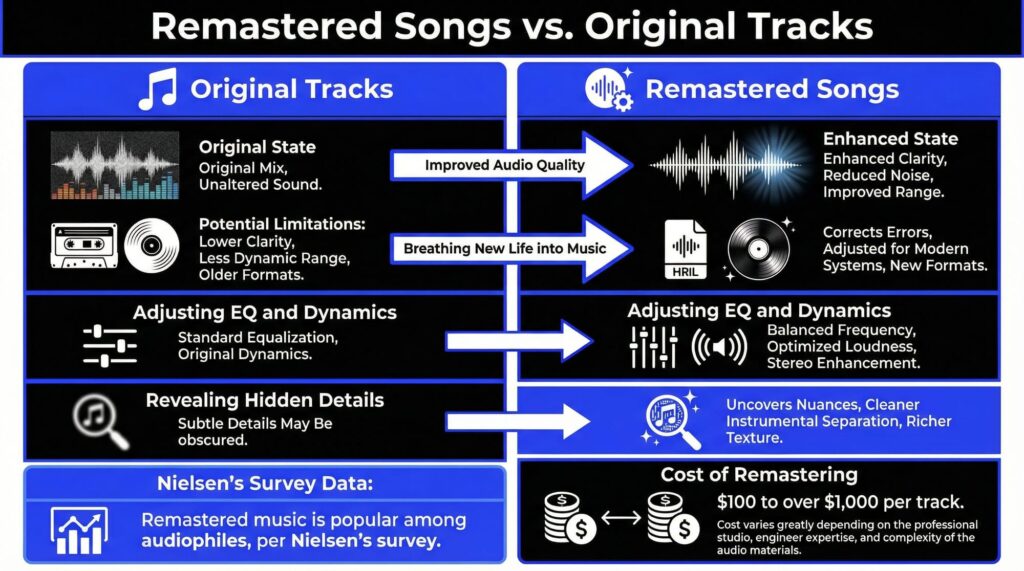
What Each Label Actually Means
These labels describe what changed between versions, not which one is automatically better. Before comparing sound quality, first determine whether the release uses the original mix, a newly mastered version of that mix, a rebuilt mix from separate tracks, or a completely different performance.
- An original version is the mix and master used for the song’s first official release. “Original” describes its release history, not its technical quality. It may sound quieter, noisier, warmer, or less detailed than a later edition, but it represents the version first presented to the public.
- A remaster keeps the completed performance and basic mix intact while applying new mastering decisions. Engineers may adjust EQ, compression, limiting, stereo width, or noise reduction to prepare the existing recording for a new format or listening environment. The Library of Congress describes remastering as processing the final stereo mix as a whole rather than returning to individual multitrack elements.
- A remix rebuilds the mix from separate recorded elements. The engineer can raise the vocal, reduce a guitar, move instruments within the stereo field, change effects, edit sections, or substantially rearrange the track. The change may be subtle or immediately obvious.
- A live version is defined primarily by being a different performance, not simply by the presence of cheering. A professionally produced live release may have little audible audience noise, but differences in vocal delivery, solos, timing, instrumentation, or transitions can still show that it is not the studio recording.
Why “Louder” Does Not Automatically Mean “Better”
A remastered version may sound cleaner because noise has been reduced or the frequency balance has been adjusted. However, it is not automatically the highest-quality or most faithful edition.
Some remasters preserve wide differences between quiet and loud passages, while others use more compression to make the track consistently louder. The Library of Congress notes that mastering preferences have changed over time, including shifts between preserving dynamic range and increasing loudness for different listening environments.
Playback settings can also distort the comparison. Apple Music’s Sound Check, for example, adjusts different songs toward a similar playback volume. This means a remaster that was mastered louder may not actually play louder when normalization is enabled.
For a fair comparison, use the same device, headphones, streaming quality, and volume. Match the perceived loudness manually before deciding which version has clearer vocals, better bass, or more natural dynamics.
Also remember:
- Clearer instruments may indicate a remix, not a remaster, if their relative levels or positions changed.
- A quieter original may retain more dynamic contrast.
- A lossless file of the original mix is still the original version, not necessarily a remaster.
- A high-resolution label cannot restore musical detail that was never present in the source.

The Best Version Depends on How You Prefer to Listen
There is no single “best” version. The right choice depends on whether you value historical authenticity, cleaner modern sound, a different creative interpretation, or the energy of a live performance.
| Version | Choose it when | What you are likely to hear | Main trade-off |
|---|---|---|---|
| Original | You want the version closest to the song’s first official release and the production choices of its era. | The original mix, tonal balance, dynamics, and period-specific recording character. | It may sound quieter, noisier, or less detailed than later editions. |
| Remaster | You want the same performance and basic mix with a potentially cleaner transfer or more modern tonal balance. | Lower noise, adjusted EQ, greater clarity, or different overall loudness. | A remaster is not automatically better; excessive compression or processing may reduce the original dynamics. |
| Remix | You want to hear familiar material from a different production perspective. | Changed vocal or instrument levels, stereo placement, effects, edits, or arrangement. | It may reveal previously buried details but move away from the artistic balance of the original release. |
| Live | You care most about the performance itself and how the song changes on stage. | Different phrasing, extended solos, altered instrumentation, improvisation, venue ambience, and audience energy. | The recording may be less controlled or technically polished than a studio version. |
The quickest final rule is: Different performance means live or re-recorded. Different balance or arrangement means remixed. The same performance and mix with only overall sound processing changed means remastered. The first released version is the original.